


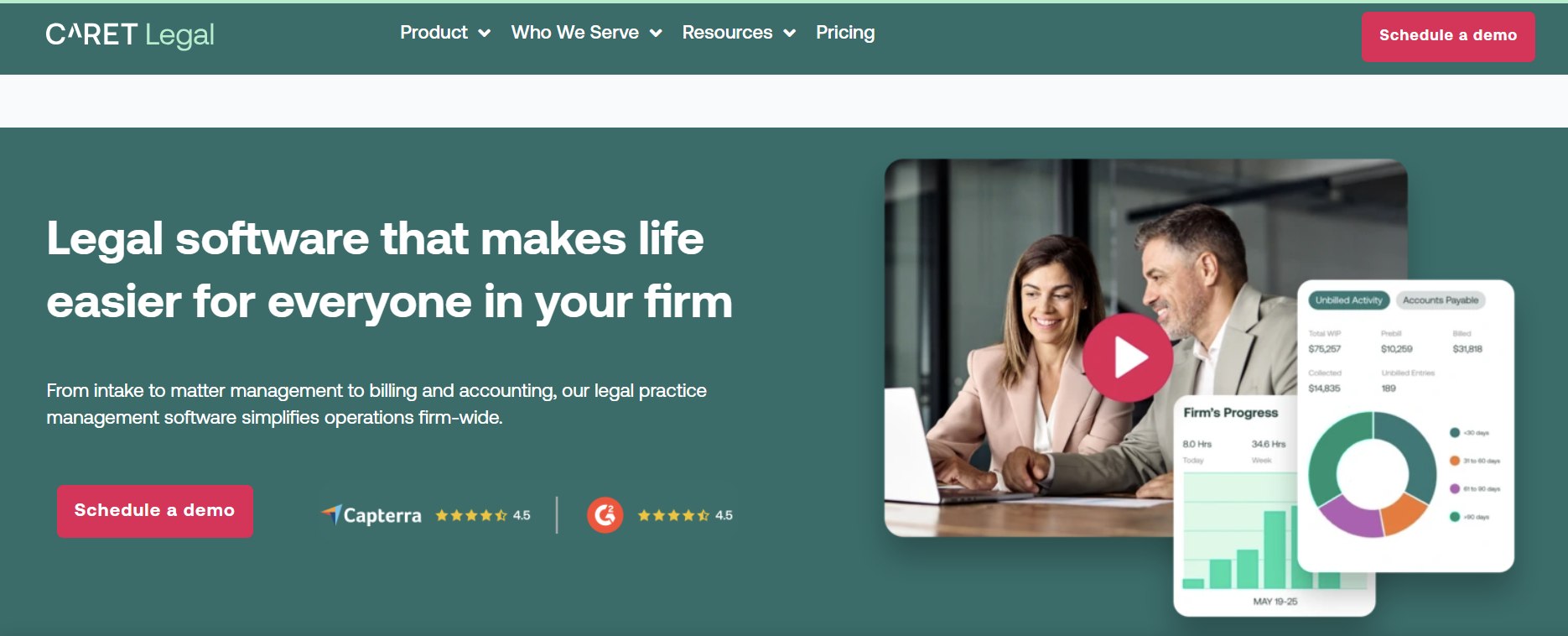
Category: Law Practice Management Software Best For: Small to mid-sized law firms Starting Price: ~$150 per user/month (custom quotes available) Rating: 4.5/5 (based on 155+ verified reviews on Capterra and G2)
Overview
CARET Legal — formerly known as Zola Suite, and before that Abacus Law — has evolved into one of the more compelling all-in-one law practice management platforms on the market today. Where many competitors have taken a modular approach, requiring firms to stitch together billing, document management, and accounting tools from disparate vendors, CARET Legal has doubled down on a unified platform philosophy: everything a law firm needs, under one roof, with one login.
That ambition is both its greatest strength and the source of its most common criticisms. When the platform works well — and for most users, it does — it delivers meaningful efficiency gains across the entire firm lifecycle, from client intake to invoice collection. When it stumbles, the integrated nature of the system means problems can ripple across workflows rather than being isolated to a single tool.
For 2026, CARET Legal continues to serve small and mid-sized law firms as its primary audience, with reviewer data showing that roughly 99% of its users come from small businesses and nearly two-thirds from law practices specifically. This review takes a close look at what it does well, where it falls short, and whether it’s the right fit for your firm.
Background: From Zola Suite to CARET Legal
Understanding CARET Legal’s history helps contextualize where the product stands today. The platform launched as Zola Suite, positioning itself as a cloud-native alternative to legacy desktop tools. It was later rebranded as part of the CARET family of legal technology products. CARET — which also owns AbacusNext and other legal software brands — has used the umbrella to consolidate features and unify support and development resources under a single brand.
The rebranding has been somewhat controversial. Some longtime users of Abacus Law, the firm’s older desktop-based product, found themselves nudged — or in some cases, effectively required — to migrate to CARET Legal as support for legacy software wound down. That transition friction has colored some of the negative reviews you’ll find online. However, for new firms evaluating the platform fresh, those legacy concerns are largely irrelevant. What matters is whether the current product delivers value, and for the most part, it does.
Key Features
Matter Management
At the core of any legal practice management platform is matter management, and CARET Legal handles this well. The platform provides a centralized workspace where attorneys, paralegals, and support staff can track case details, deadlines, contacts, and related documents in one place. Real-time updates mean that everyone on a matter has a current picture of where things stand, without relying on manual status updates or separate project management tools.
Each matter serves as a hub: emails, tasks, documents, time entries, and communications are all linkable to a specific case, which eliminates the fragmented experience of hunting across inboxes, shared drives, and spreadsheets.
Document Management and Automation
CARET Legal’s document capabilities are a genuine differentiator. The platform supports document generation using built-in templates and merge fields, which allows firms to auto-populate standard legal documents — engagement letters, retainer agreements, court filings — with client and matter data. This reduces both the time spent on drafting and the risk of manual errors.
Documents are organized within each matter and benefit from robust search and indexing, making retrieval fast even in cases with large file volumes. Version control is also supported, which is essential for collaborative legal drafting where multiple attorneys may be working on a document.
For firms that rely heavily on external document repositories, CARET Legal integrates with NetDocuments, iManage, and OneDrive, giving users flexibility in where their files ultimately live.
Time Tracking and Billing
Billing is arguably where CARET Legal earns its keep. The platform includes precision time-tracking tools that allow attorneys to log billable hours directly within a matter or task. Timers can run in the background while users work, and easy-entry forms reduce the friction that typically leads to lost billable time at the end of a long day.
Invoice generation is customizable, accurate, and — according to most users — genuinely easy to use. The platform supports multiple billing formats including hourly, flat fee, and contingency arrangements. Trust accounting is also built in and compliant with standard bar requirements, which is critical for firms managing client retainers.
CARET Legal reports that firms using the platform recoup their software investment 31% faster than the legal practice management category average on G2 — a claim that, while self-reported, aligns with the billing efficiency improvements users consistently cite in reviews.
Integrated Accounting
One of CARET Legal’s most significant selling points is its fully integrated accounting module. Unlike platforms that rely solely on QuickBooks integrations for back-office financial management, CARET Legal offers native accounting functionality that covers operating accounts, trust accounts, and financial reporting without requiring a separate system.
For firms tired of reconciling discrepancies between a billing platform and a standalone accounting tool, this native integration is a genuine time-saver. Users can generate financial reports, monitor profitability by matter or practice area, and track cash flow — all from within the same platform where they manage cases and billing.
That said, QuickBooks Online integration is also available for firms that prefer to maintain their existing accounting workflow.
Email Integration
CARET Legal’s bi-directional email integration is a standout feature. Rather than offering a superficial email-to-case linking function, the platform includes a native email client that syncs with Gmail (via Google Workspace) or Microsoft Outlook/Exchange (via Microsoft 365), allowing attorneys to manage case-related correspondence directly within CARET Legal without switching between applications.
Emails can be associated with specific matters automatically or manually, keeping the case communication record complete and searchable. For firms that run a large volume of client email, this feature alone can justify the subscription cost by reducing the time spent manually filing and searching for correspondence.
IMAP support is also available, though it is more limited in functionality than the native Microsoft 365 and Google Workspace integrations.
Calendar and Deadline Management
The built-in legal calendar tracks court dates, internal events, and deadlines in real time, with rule-based functionality designed specifically for legal workflows. The calendar integrates with Google Calendar and Microsoft Outlook, ensuring that events created in CARET Legal appear in attorneys’ external calendars and vice versa.
LawToolBox integration is also available, enabling automatic calculation of court deadlines based on jurisdiction-specific rules. Some users have noted occasional inaccuracies in federal deadline calculations, which is worth monitoring if your practice depends heavily on precise deadline tracking.
Workflow Automation
The Enterprise Plus and Enterprise Insights tiers include workflow automation capabilities that allow firms to create trigger-based processes for routine tasks — client onboarding sequences, document request reminders, invoice follow-ups, and more. This is particularly valuable for growing firms where administrative bandwidth is limited and consistency across client intake matters.
Automated workflows reduce the risk of things falling through the cracks during busy periods and allow administrative staff to focus on higher-value work rather than repetitive follow-up tasks.
Reporting and Analytics
CARET Legal provides customizable dashboards and financial reports that give firm leadership visibility into performance metrics including productivity by attorney, accounts receivable aging, billing realization rates, and overall profitability. The Enterprise Insights tier expands these capabilities further with more advanced analytics tools.
For managing partners who want data to inform staffing, pricing, and business development decisions, the reporting module provides the kind of granular insight that generic accounting software typically cannot offer.
Client Portal and Communication
The platform includes a secure client portal that allows firms to communicate with clients, share documents, and collect electronic signatures without relying on unsecured email. Client-facing communication through the portal is logged and associated with the relevant matter, creating an auditable record of all firm-client interactions.
Mobile Access
CARET Legal is fully mobile-responsive as a web application and also offers dedicated iOS and Android apps. The mobile apps support biometric authentication, adding a layer of security for attorneys who need to access case information or log time while away from the office.
Integrations
CARET Legal connects with a focused set of third-party tools that cover the core needs of most law firms:
Email and Productivity: Microsoft 365, Microsoft Outlook, Google Workspace (Gmail + Google Calendar), IMAP
Document Management: OneDrive, NetDocuments, iManage
Accounting: QuickBooks Online
Payments: LawPay
Deadline Management: LawToolBox
Security: RMail (encrypted email delivery)
One notable limitation is the absence of Zapier or similar no-code automation connectors. CARET Legal offers an API for firms with development resources who want to build custom integrations, but firms that rely on Zapier-based workflows to connect their legal tools to other business applications will find the ecosystem more constrained than they might prefer.
Pricing
CARET Legal operates on a custom pricing model across three tiers: Enterprise, Enterprise Plus, and Enterprise Insights. All plans include native case management capabilities and integrated payment processing.
Enterprise Plus adds automated workflows, custom permissions, and departmental accounting. Enterprise Insights extends the analytics capabilities available to firm leadership.
Published estimates place the starting price at approximately $150 per user per month, though actual pricing varies based on firm size and selected features. Interested firms should request a direct quote from CARET Legal, as the vendor does not publish a public pricing page.
For small and mid-sized firms, the cost is generally regarded as competitive relative to the feature depth on offer — particularly for firms that would otherwise need to pay separately for billing software, accounting tools, and document management.
Pros
All-in-one platform. Case management, billing, accounting, email, and documents in a single system eliminates the inefficiency and reconciliation headaches of managing multiple tools.
Native accounting with trust accounting. Built-in accounting that meets bar requirements is a differentiator versus competitors that rely entirely on QuickBooks integration.
Excellent email integration. True bi-directional sync with Google Workspace and Microsoft 365 sets the platform apart from competitors that offer only basic email linking.
Clean, intuitive interface. The platform is consistently praised for its ease of use, especially relative to legacy tools. New staff can get up to speed quickly without extensive training.
Responsive customer support. Users consistently highlight knowledgeable, responsive support and strong onboarding assistance from dedicated account managers.
Strong billing efficiency. Tight integration between time tracking, billing, and client records reduces lost billable time and accelerates invoice collection.
Mobile apps with biometric security. Full mobile support with iOS and Android apps, including biometric authentication.
Cloud-based and accessible. Access from any device, anywhere, without the infrastructure overhead of on-premise software.
Cons
Occasional performance issues. A recurring theme in user reviews is lag — particularly when handling large datasets, generating reports, or loading the calendar. For high-volume firms, this can be a meaningful friction point.
Limited Zapier/automation connectivity. The absence of Zapier integration limits flexibility for firms that want to connect CARET Legal to a broader tech stack without engaging developer resources.
No public pricing. The lack of a published pricing page makes it harder for small firms to budget-qualify the platform before entering a sales conversation.
Pricing can be steep for smaller practices. For solo practitioners or very small firms, the per-user monthly cost may be difficult to justify against simpler, cheaper alternatives.
Some hard-to-find features. A subset of users notes that certain capabilities are present but not easily discoverable, which can lead to underutilization in the early months.
Billing and accounting limitations reported by some users. While most users praise the billing tools, a minority report recurring bugs or limitations in accounting functions, particularly around edge cases in financial workflows.
No Zapier or API for non-developers. Custom integrations require developer resources, limiting flexibility for smaller teams.
Who Is CARET Legal Best For?
CARET Legal is strongest for small to mid-sized law firms — generally those with 5 to 50 attorneys — that want a single platform to run the full scope of practice operations without managing a patchwork of disconnected tools. It is especially well-suited for firms that:
- Currently use Microsoft 365 or Google Workspace for email
- Want native trust accounting without a separate bookkeeping subscription
- Are moving off legacy software like Abacus Law or a similarly aging platform
- Need robust document automation alongside billing and case management
- Value a clean, modern interface that minimizes staff training time
It is likely not the best fit for solo practitioners on tight budgets, firms that rely heavily on Zapier-based automations, or practices with highly bespoke workflow requirements that demand deep software customization.
Verdict
CARET Legal is a mature, capable law practice management platform that delivers genuine value for the firms it serves best. Its commitment to keeping billing, accounting, document management, email, and case management under one roof — rather than outsourcing critical functionality to third-party integrations — is a meaningful advantage for firms that have experienced the fragmentation pain of managing multiple tools.
The platform is not without its weaknesses: occasional performance lag, limited third-party automation connectivity, and pricing opacity are real concerns. But for a small to mid-sized firm evaluating cloud-based practice management solutions in 2026, CARET Legal belongs squarely on the shortlist — particularly for those who prioritize integrated accounting and a polished user experience over a broad integration ecosystem.
Overall Score: 4.3 / 5
| Category | Score |
|---|---|
| Features | 4.5 / 5 |
| Ease of Use | 4.4 / 5 |
| Value for Money | 4.2 / 5 |
| Customer Support | 4.4 / 5 |
| Integrations | 3.8 / 5 |
Pricing and feature information is based on publicly available data and user reviews as of June 2026. Contact CARET Legal directly for a current pricing quote tailored to your firm’s size and requirements.