


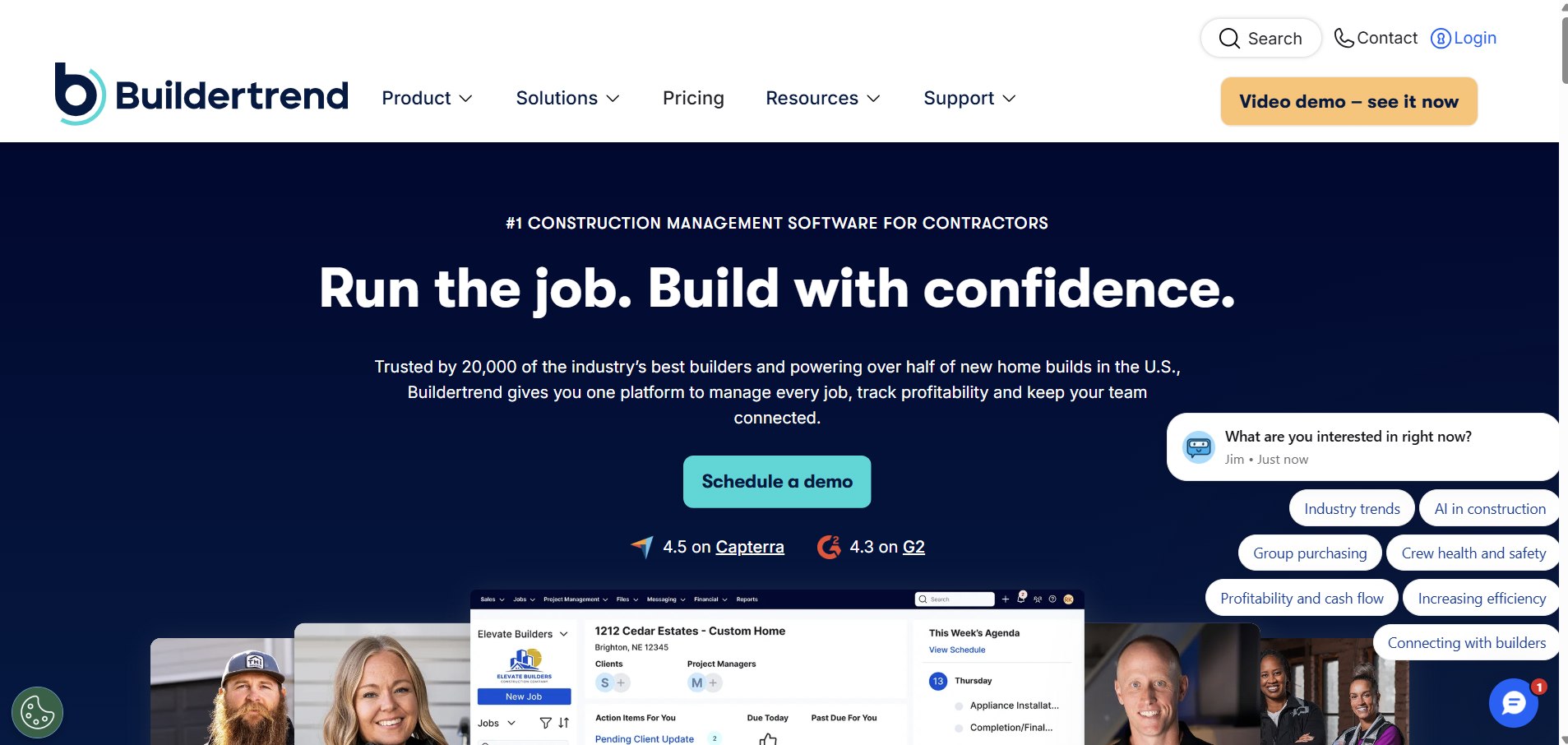
Buildertrend remains one of the leading all-in-one construction management platforms in 2026, particularly for residential home builders, remodelers, and specialty trade contractors. Designed to streamline everything from initial lead capture to final warranty management, Buildertrend has evolved significantly over the past year with enhanced financial tools, improved mobile functionality, and tighter integrations that address the growing complexity of running a construction business in a competitive market.
This in-depth review examines Buildertrend’s core features, recent 2026 updates, pricing structure, real-world pros and cons, and how it compares to top alternatives. Whether you’re a small custom builder managing a handful of projects or a growing remodeler handling dozens of jobs simultaneously, this guide will help you determine if Buildertrend is the right fit for your operation in 2026.
What Is Buildertrend?
Buildertrend is a cloud-based construction management software platform that serves as a centralized hub for project planning, client communication, financial tracking, scheduling, and document management. Founded with residential builders in mind, it has grown into a comprehensive operating system for construction businesses of varying sizes.
In 2026, Buildertrend continues to focus on residential and light commercial contractors who need more than basic task management. The platform emphasizes transparency between builders, clients, subcontractors, and internal teams — a critical need as projects become more complex and clients demand greater visibility into timelines and budgets.
Core Features in 2026
Project Scheduling and Management Buildertrend’s drag-and-drop Gantt chart scheduling remains one of its strongest features. Users can create templates for recurring project types, set dependencies, assign tasks to team members or subs, and track progress in real time. The 2026 updates introduced improved resource leveling and automated notifications when tasks fall behind schedule. Daily logs, punch lists, and photo documentation keep everything organized and auditable.
Client Communication Portal The client portal has been a standout since early versions and continues to impress in 2026. Clients can view project timelines, approve selections, upload photos, sign documents, and make payments directly through a branded, professional interface. This feature significantly reduces back-and-forth emails and phone calls while improving client satisfaction scores.
Financial Management and Estimating Buildertrend offers robust job costing, change order management, invoicing, and budget tracking. The Advanced and Complete plans include detailed estimating tools with material takeoffs and real-time cost comparisons. New in 2026 is the enhanced WIP (Work in Progress) report that provides clearer visibility into percent complete, earned revenue, and over/under billing — helping builders maintain healthy cash flow and accurate financial forecasting.
Selections and Warranty Management For custom builders and remodelers, the selections module allows clients to choose finishes, fixtures, and materials digitally with visual approvals. The warranty management tool tracks post-project service requests efficiently, turning potential headaches into organized processes.
Document Management All project files, contracts, plans, and communications are stored centrally with version control and easy search functionality. Digital signature capabilities have been streamlined, allowing faster contract execution and change order approvals.
Mobile App The Buildertrend mobile app received notable improvements in 2026, with faster syncing, better offline functionality, and enhanced photo markup tools. Field teams can update progress, log hours, and communicate seamlessly from job sites.
Integrations
Buildertrend offers solid native integrations with popular accounting software including QuickBooks Desktop, QuickBooks Online, Xero, and Foundation. It also connects with marketing tools like HubSpot and Salesforce for lead management. The platform’s open API allows custom integrations through third-party tools such as Zapier, making it more flexible than in previous years.
Popular additional integrations in 2026 include payment processors like Stripe, supplier portals, and material pricing databases that pull real-time costs directly into estimates.
Pricing in 2026
Buildertrend uses a tiered subscription model with three main plans:
- Essential: Starts around $499/month (billed annually) — includes core scheduling, client portal, basic financials, and unlimited users.
- Advanced: Around $799/month — adds detailed estimating, change orders, takeoffs, and advanced reporting.
- Complete: Around $1,099/month — includes everything plus selections, warranties, premium support, and enhanced analytics.
Pricing is often customized based on company size, annual revenue, and number of active projects. Buildertrend frequently offers discounts on annual billing and sometimes waives setup fees for new customers. There is no free plan, but a demo is available. Many users note that while the cost is higher than some basic tools, the all-in-one nature can replace multiple software subscriptions, potentially saving money overall.
Pros of Buildertrend in 2026
Comprehensive All-in-One Platform Few competitors match Buildertrend’s breadth. From pre-sale lead tracking to post-construction warranties, the platform covers nearly every aspect of running a residential construction business.
Excellent Client-Facing Tools The client portal consistently receives high praise for improving transparency and reducing miscommunication. Clients love being able to see progress in real time.
Strong Customer Support Buildertrend is known for responsive, construction-savvy support staff. Unlimited training is included, which helps offset the learning curve for new users.
Regular Updates and Innovation The company continues to invest in meaningful improvements, such as the enhanced WIP reporting and better mobile experience in 2026.
Scalability Suitable for small one-person operations up to larger firms managing dozens of projects simultaneously.
Cons of Buildertrend in 2026
Steep Learning Curve New users often report that it takes several weeks to become fully proficient. The sheer number of features can feel overwhelming initially.
Pricing May Feel High for Smaller Teams While justified for active builders, the monthly cost can be prohibitive for very small operations or those just starting out.
Occasional Performance Issues Some users report slower loading times during peak usage or when working with very large projects containing thousands of photos and documents.
Limited Offline Functionality Although the mobile app has improved, full offline capabilities remain restricted compared to some competitors.
Customization Limitations While flexible, certain workflows still require workarounds for highly specialized trades or unique business processes.
Who Should Use Buildertrend?
Buildertrend is an excellent fit for:
- Custom home builders managing 10+ projects per year
- Remodeling companies focused on client experience
- Specialty contractors who need strong scheduling and financial tracking
- Growing businesses ready to replace spreadsheets and multiple disconnected tools
It may be overkill for very small solo operators or those who only need basic scheduling and invoicing.
Buildertrend vs. Competitors in 2026
Vs. Procore: Procore is stronger for large commercial projects, while Buildertrend excels in residential with better client portals and lower cost.
Vs. JobNimbus: JobNimbus is often cheaper and simpler for smaller roofing or specialty trades, but lacks Buildertrend’s depth in full financial management.
Vs. CoConstruct: CoConstruct offers strong selection tools but is generally considered less robust in overall project financials than Buildertrend.
Vs. Contractor Foreman: Contractor Foreman is significantly more affordable but lacks the polished client experience and advanced reporting of Buildertrend.
Final Verdict: Is Buildertrend Worth It in 2026?
Buildertrend earns a strong recommendation for mid-sized residential construction businesses that value organization, client communication, and comprehensive financial visibility. While the learning curve and price point are legitimate concerns, the platform’s ability to replace multiple tools and improve overall business efficiency often delivers strong ROI for active builders.
The 2026 updates demonstrate Buildertrend’s commitment to evolving with industry needs — particularly around financial reporting, mobile usability, and client collaboration. For companies serious about professionalizing their operations and scaling responsibly, Buildertrend remains one of the most capable solutions available.
If you’re considering Buildertrend, request a personalized demo and ask to speak with current customers in your specific trade and company size. The platform’s true value becomes clear once you see how it can transform chaotic project communication into streamlined, professional workflows.
In an increasingly competitive and complex construction market, tools like Buildertrend that bring structure, transparency, and data-driven decision making are becoming essential rather than optional. For many builders in 2026, the investment pays for itself through reduced errors, happier clients, and better project margins.