


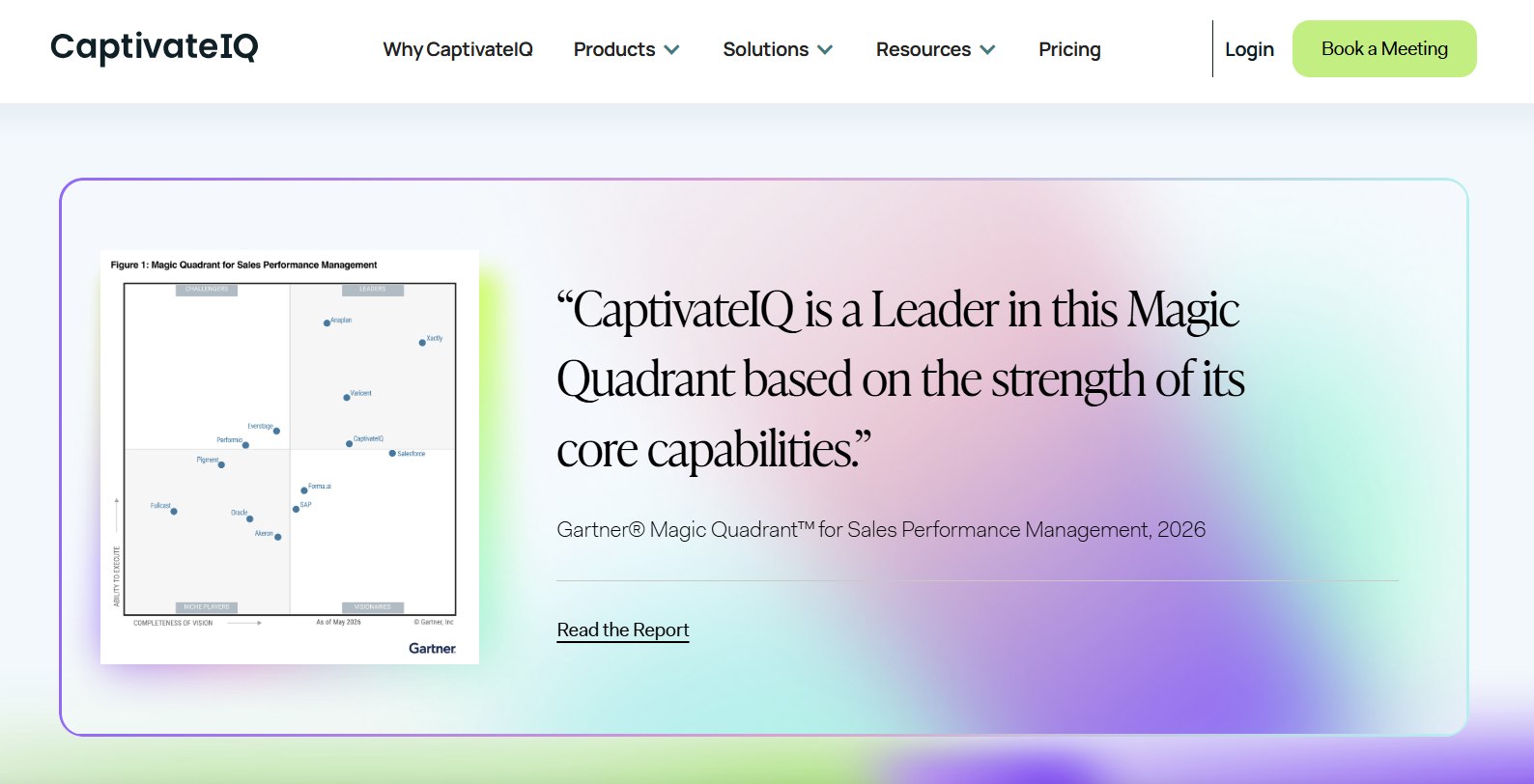
Sales organizations in 2026 face mounting pressure to align compensation with strategy while eliminating spreadsheet errors, delayed payouts, and opaque calculations. CaptivateIQ has emerged as a leading answer to these challenges. Positioned as a unified sales performance management (SPM) platform, it combines incentive compensation management, quota and capacity planning, territory design, and AI-driven insights into one workspace. In July 2026, Gartner named CaptivateIQ a Leader in the Magic Quadrant for Sales Performance Management, recognizing both its ability to execute and completeness of vision.
This review examines CaptivateIQ’s current capabilities, recent AI advancements, integrations, pricing realities, strengths, limitations, and suitability for different organizations. The assessment draws from official product information, user feedback patterns, third-party benchmarks, and 2026 platform updates.
What Is CaptivateIQ?
FoundCaptivateIQ Software Review 2026: Features, Integrations, Pros & Cons
Sales organizations in 2026 face mounting pressure to align compensation with strategy while eliminating spreadsheet errors, delayed payouts, and opaque calculations. CaptivateIQ has emerged as a leading answer to these challenges. Positioned as a unified sales performance management (SPM) platform, it combines incentive compensation management, quota and capacity planning, territory design, and AI-driven insights into one workspace. In July 2026, Gartner named CaptivateIQ a Leader in the Magic Quadrant for Sales Performance Management, recognizing both its ability to execute and completeness of vision.
This review examines CaptivateIQ’s current capabilities, recent AI advancements, integrations, pricing realities, strengths, limitations, and suitability for different organizations. The assessment draws from official product information, user feedback patterns, third-party benchmarks, and 2026 platform updates.
What Is CaptivateIQ?
Founded in 2017 in San Francisco by former sales operations leaders, CaptivateIQ was built to replace broken spreadsheets and rigid legacy commission systems. It now serves more than 800 companies worldwide (some sources cite 1,000+), processing trillions of real-time calculations monthly. Notable customers include Gong, Tipalti, Clari, Reddit, Udemy, Expedia, and Boston Scientific.
The platform sits at the intersection of incentive compensation management (ICM) and broader sales planning. Its core promise is to let RevOps, sales finance, and compensation teams design, model, execute, and adapt plans without constant reliance on IT or external services. The proprietary SmartGrid ELT and calculation engine underpins this flexibility, enabling real-time data ingestion, transformation, and modeling at enterprise scale.
In 2026 the company has leaned heavily into generative AI agents and predictive capabilities while maintaining its no-code, spreadsheet-familiar modeling experience.
Core Features
SmartGrid ELT & Calculation Engine
SmartGrid is the technical foundation. It functions as an in-app extract-load-transform (ELT) engine that connects to virtually any data source, cleans and shapes the data in real time, and powers complex calculations. Users work in a visual, logic-based interface that feels familiar to Excel users yet supports sophisticated rules—accelerators, decelerators, multi-tier structures, splits, overrides, clawbacks, SPIFs, and draws—without writing code.
Key advantages include:
- Continuous synchronization with closed revenue and CRM data
- Immediate visibility into plan impact when assumptions change
- Capacity to process extremely large volumes (reportedly over 6–8 trillion calculations per month across the customer base)
- Collaboration features so stakeholders can review models before go-live
This engine is what allows mid-quarter plan adjustments that once took days or weeks to ship in hours.
Incentive Compensation Management
The ICM module automates the full commission lifecycle. Administrators build plans visually, define eligibility and credit rules, run automated calculations, generate detailed statements, and manage multi-level approval workflows. Payees receive real-time dashboards showing attainment, projected earnings, and deal-level breakdowns. Audit trails and version history support compliance and dispute resolution. The system is designed for accuracy and transparency—two of the most frequently praised attributes in user feedback.
Sales Capacity, Quota & Territory Planning
Beyond pure commissions, CaptivateIQ includes modules for capacity modeling, quota setting, and territory management. Teams can balance workloads, account for ramp times, run scenario comparisons, automatically assign accounts, and adjust boundaries while maintaining alignment between sales and operations. These planning capabilities connect directly to incentive models, creating a single source of truth rather than disconnected spreadsheets.
Reporting, Analytics & Predictive Modeling
Real-time dashboards surface performance trends, top performers, and attainment gaps. Machine-learning models forecast outcomes, score accounts, predict quota attainment, and flag payout anomalies. The combination of historical data and predictive insights helps leaders move from reactive administration to proactive strategy.
AI Capabilities in 2026
CaptivateIQ has significantly expanded its AI layer. Assist AI supports natural-language queries for plan building, formula troubleshooting, documentation search, and optimization suggestions. In June 2026 the company introduced a portfolio of specialized agents:
- Comp Builder Agent – Constructs or replicates compensation plans from existing data.
- Comp Ops Agent – Automates operational workflows and reduces manual coordination between admins and reps.
- Rev Planning Agent (closed beta as of mid-June 2026) – Explains planning models in plain language, traces quota formulas, maps dependencies, and clarifies account assignments.
These agents aim to compress the time required for plan design and ongoing administration while improving accessibility for non-technical users.
Integrations
CaptivateIQ emphasizes native and flexible connectivity so data flows without constant manual intervention. Major categories include:
CRM Salesforce, HubSpot, Microsoft Dynamics CRM
HR / HCM Workday, BambooHR, ADP Workforce Now
Finance / ERP / Accounting NetSuite, Sage Intacct, QuickBooks Online, Xero, Stripe, Zuora
Data Warehouses & Databases Snowflake, Google BigQuery, Amazon Redshift, MySQL, PostgreSQL, Oracle Database
Additional options include an open API and SFTP for custom or file-based transfers.
The platform’s data connectors and SmartGrid transformations mean structural changes in source systems (new hires, promotions, territory realignments) can automatically flow into compensation assumptions. This reduces the classic “data reconciliation tax” that plagues spreadsheet-based processes.
Pricing
CaptivateIQ does not publish fixed list prices. Pricing is custom and typically structured as a per-seat annual subscription (covering admin users plus payees) plus a one-time implementation/setup fee. Cost drivers include number of payees, plan complexity, required integrations, selected modules (core ICM versus full planning suite), and support tier.
Third-party marketplace data from 2026 suggests negotiated deals often land in the range of roughly $35–$60 per user per month when annualized, with larger enterprise contracts receiving volume discounts. Implementation commonly takes around three months, depending on complexity.
Organizations should budget for professional services during onboarding and potential ongoing managed-support options. The total cost of ownership is higher than pure mid-market point solutions but is frequently justified by reduced administrative headcount, faster plan changes, and improved payout accuracy.
Pros
Exceptional flexibility for complex plans The no-code SmartGrid engine handles sophisticated multi-component structures that break simpler tools or require heavy IT involvement. Users consistently highlight the ability to iterate quickly.
Real-time accuracy and transparency Payees and managers see live attainment and projected earnings. Automated calculations and audit trails reduce disputes and build trust.
Strong AI trajectory in 2026 The introduction of specialized agents and Assist AI meaningfully accelerates plan design and operational tasks—an important differentiator as competitors race to add generative capabilities.
Robust enterprise integrations and data handling Native connectors plus the ELT layer create a reliable single source of truth across CRM, HR, finance, and data warehouses.
Proven scalability and recognition Gartner Leader status, processing of trillions of calculations, and a growing customer base of 800+ organizations demonstrate maturity for mid-market and enterprise use cases.
Measurable efficiency gains Customer examples cite dramatically faster commission processing (sometimes 60x), significant monthly hours saved, and accelerated plan rollout times.
Responsive support and implementation focus Many reviews note thorough onboarding and helpful customer success teams, which is critical given the platform’s depth.
Cons
Premium pricing The custom, seat-based model and implementation services place CaptivateIQ at the higher end of the market. Smaller teams or those with simple plans may find better value elsewhere.
Implementation time and learning curve Average go-live around three months and a non-trivial learning period for administrators and end users can delay time-to-value. Some sales managers and reps report needing training to fully leverage dashboards and statements.
Occasional performance friction with very large datasets A minority of users mention sync delays or slower loading when handling extremely high data volumes, though the engine is designed for scale.
Limited mobile experience and some reporting rigidity Mobile access is functional but not a primary strength. Certain statement layouts and report customizations are less flexible than pure BI tools, sometimes requiring exports for advanced analysis.
Potential overkill for straightforward needs Organizations with simple, stable commission structures may not need the full planning suite or AI agents and could achieve similar outcomes with lighter, lower-cost alternatives.
Who Should Consider CaptivateIQ?
CaptivateIQ is best suited for mid-market and enterprise sales organizations that:
- Manage complex or frequently changing compensation plans
- Need to connect incentives tightly with quota, capacity, and territory planning
- Value real-time visibility for large payee populations
- Have dedicated RevOps or sales finance resources to administer the system
- Prioritize accuracy, auditability, and strategic agility over lowest possible cost
It is less ideal for very small teams, companies with purely transactional simple plans, or those seeking a lightweight, self-serve tool with transparent low pricing.
Alternatives Snapshot
Common alternatives include Xactly and Varicent (strong enterprise legacy players), Salesforce’s Spiff acquisition, Performio, Everstage, and newer mid-market options such as Visdum. CaptivateIQ generally differentiates on modeling flexibility, modern AI agents, and the depth of its planning-plus-incentives unification. Evaluation should focus on specific plan complexity, existing tech stack, and internal administrative capacity.
Final Verdict
In 2026 CaptivateIQ stands as one of the most capable and forward-looking platforms in sales performance management. Its SmartGrid foundation, expanding AI agent suite, comprehensive planning modules, and Gartner Leader recognition make it a compelling choice for organizations that treat incentive compensation as a strategic lever rather than a pure administrative burden. The platform delivers measurable reductions in calculation time, error rates, and plan-change friction while giving sellers clearer visibility into their earnings.
The trade-offs—higher cost, meaningful implementation effort, and a learning curve—are real. For companies whose compensation complexity and growth trajectory justify the investment, however, CaptivateIQ offers a robust, future-ready system that turns sales expenses into aligned business drivers. Prospective buyers should request a tailored demo focused on their actual plan structures and data sources, then carefully model total cost of ownership against expected efficiency and accuracy gains.
Overall, CaptivateIQ has solidified its position as a top-tier SPM solution for the mid-to-large enterprise segment heading into the second half of the decade.