

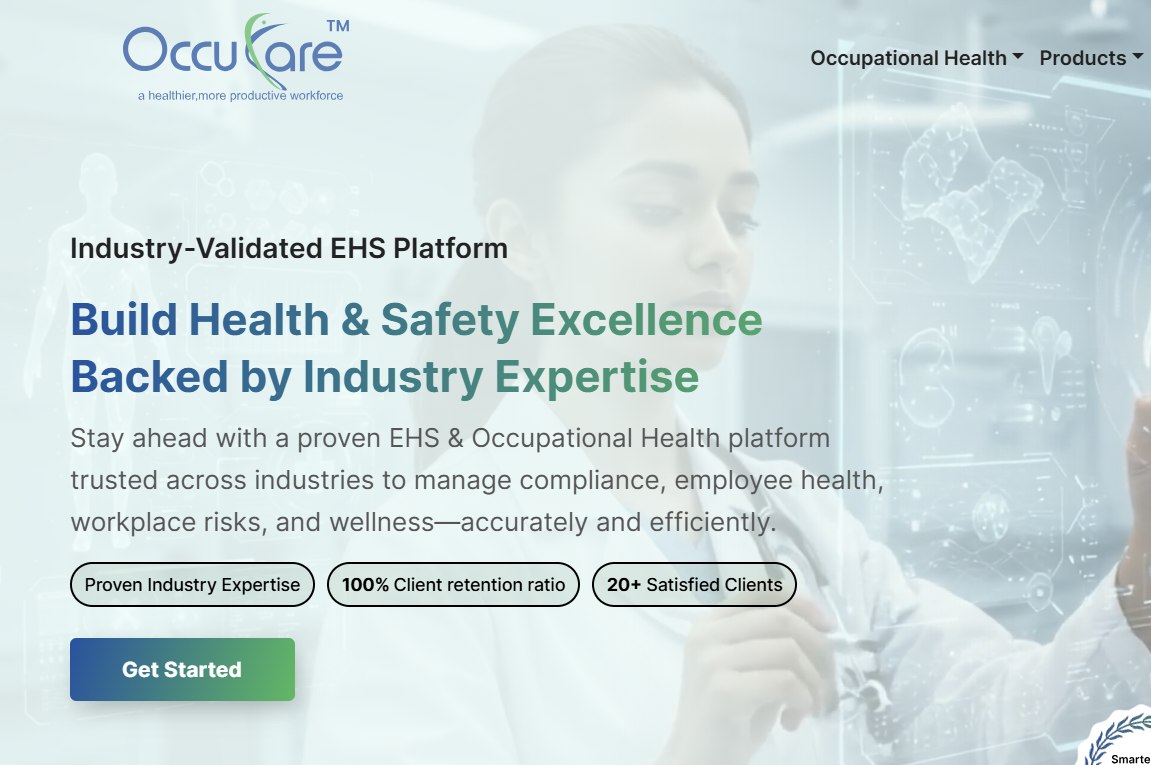
Occupational health and safety management has become a critical operational priority for industrial and manufacturing organizations. Beyond general employee wellness apps, companies with on-site clinics, regulatory obligations, and high-risk work environments need specialized systems that handle medical surveillance, incident tracking, compliance documentation, and centralized health records. OccuCare, developed by Sapphire Health Solutions (also associated with Sapphire Software Solutions), is designed precisely for this purpose.
Positioned as a comprehensive occupational health management and employee wellness platform, OccuCare digitizes Occupational Health Centre (OHC) operations from pre-employment examinations through retirement. It generates compliance forms automatically, calculates individual health indices, tracks vaccines and lifestyle diseases, and provides 360-degree employee health reports. A mobile application extends access to employees and clinicians. This 2026 review examines its features, integrations, pricing approach, user feedback, strengths, limitations, and suitability for different organizations.
What Is OccuCare?
OccuCare is a web-based occupational health and safety (OHS) software solution that centralizes employee medical data, automates clinical workflows, and supports regulatory compliance. It serves occupational health professionals, safety managers, HR teams, and compliance officers across industries such as manufacturing, automotive, pharmaceuticals, oil & gas, chemicals, engineering, mining, power generation, and government.
The platform has been in use for over 15–23 years (depending on the metric cited by the vendor), with claims of 150+ Occupational Health Centres digitized, 100% client retention, and a team of more than 200 IT professionals. Headquarters are in Ahmedabad, India, with additional offices or presence in the USA, Canada, Australia, UK, and UAE. It is used by large enterprises and multi-site organizations seeking to move away from paper registers and fragmented spreadsheets toward a unified digital system.
Core value propositions include reducing administrative burden on OHC staff, ensuring audit-ready compliance, improving data accuracy, enabling trend analysis of workforce health, and supporting both clinical care and broader wellness initiatives.
Core Features and Modules
OccuCare is modular, covering health, safety, and operational functions typically required in an industrial OHC setting.
Employee Information and Medical Records The system maintains comprehensive employee profiles, including personal details, job roles, medical history, and dependent information. Records span the full employment lifecycle. Bulk import capabilities and integration points with HR systems help keep data current. Electronic health records centralize clinical data, lab results, and visit histories.
Appointment and Clinical Visit Management Digital appointment scheduling replaces paper diaries. Occupational health medical officers can manage outpatient department (OPD) visits, record complaints, diagnoses, prescriptions, and requested tests. Group appointments and department-priority scheduling are supported. Automated reminders help ensure employees attend due physicals, vaccines, audiometric tests, and other assessments.
Medical Surveillance This module handles pre-employment, periodic, pre-placement, post-sickness, and pre-retirement examinations. Organizations can define examination protocols by job role or risk category, track completion, and maintain historical records. Health index calculations based on critical parameters allow analysis of individual and group health trends. Lifestyle disease tracking and vaccination logs further support proactive management.
Diagnostic and Specialized Interventions Modules cover diagnostic test assignment, hearing conservation programs, pulmonary function testing, ophthalmic assessments, X-ray classification (including ILO standards for pneumoconiosis), and related occupational health diagnostics. These features help organizations monitor exposure-related risks.
Pharmacy, Stock, and Procurement Integrated pharmacy functionality links prescriptions to inventory. Stock management includes expiration alerts for medicines. Procurement tools support material management for clinical supplies, reducing stock-outs and waste.
Incident Management and Safety Modules Robust tools capture workplace injuries and illnesses, support investigation, root-cause analysis, and corrective/preventive actions (CAPA). Additional safety capabilities include hazard identification and risk assessment (HIRA), near-miss reporting, work permits, observations of unsafe acts, audit management, and biomedical waste tracking. These modules help organizations move from reactive to preventive safety management.
CSR, Wellness, and First Aid Wellness and corporate social responsibility programs can be managed within the platform. First-aid box inspections and related compliance activities are also covered. Claim recording supports insurance and workers’ compensation processes.
Reporting, Analytics, and Mobile Access Dashboards, standard and custom reports, compliance form generation, and data analysis tools provide visibility for management and auditors. The mobile application allows employees to view personal health trends, receive customized tips and notifications, access health cards from periodic exams, and stay informed about wellness programs. Clinicians can manage appointments and records on the go.
Overall, the breadth of modules aims to create a single system of record for occupational health operations rather than a collection of disconnected tools.
Integrations
Public documentation emphasizes internal module integration (clinical, pharmacy, stock, incident, and compliance functions working together) and the ability to import employee data from HRMS systems. Data import/export facilities support bulk operations and reporting needs.
Specific third-party named integrations are less prominently listed than in consumer-facing wellness apps. The platform is designed to interface with existing organizational systems for employee master data and, on the clinical side, to support workflows involving external labs or providers where configured. Higher-end deployments may involve custom interfaces. Organizations evaluating OccuCare should clarify current and planned connectors during the demo process, particularly for HRIS, payroll, or laboratory systems.
Pricing
Pricing is not published as fixed public tiers. Capterra and other directories list it as “Contact vendor” or “Price on Request,” with a free trial available. This is typical for specialized occupational health systems whose cost depends on the number of employees/sites, selected modules, deployment model (cloud or on-premise elements), implementation effort, training, and ongoing support.
Buyers should expect a quote-based process that includes implementation and configuration services. Total cost of ownership will reflect the reduction in manual paperwork, improved compliance readiness, and clinical efficiency rather than a simple per-user monthly fee common in lighter wellness apps.
User Reviews and Ratings
On Capterra, OccuCare holds a 4.7 overall rating based on approximately 58 reviews, with strong scores for customer service (around 4.9), features (4.6), and solid ease-of-use ratings (4.4). Sentiment is highly positive. Many reviewers are from automotive, pharmaceutical, and manufacturing organizations in India, reflecting the platform’s core market.
Frequent positive themes include:
- Significant reduction in manual registers and paperwork
- Ease of generating compliance forms and health reports
- Comprehensive coverage of OHC workflows (appointments, medical exams, stock, incidents)
- Responsive and helpful support team (often available via phone, email, or WhatsApp)
- Improved data organization and accessibility for doctors and administrators
- Useful mobile app for employee health visibility and tips
Criticisms or improvement areas mentioned by some users:
- Initial learning curve due to the large number of modules and sections
- Occasional slow performance when handling large datasets or under high server load
- Desire for more readily accessible in-app user manuals or field-level guidance
- Need for proper training and configuration during implementation
- Some interfaces or workflows that can feel dense for first-time users
Overall, organizations that invest in setup and training report strong operational benefits and high satisfaction with support.
Pros
Deep specialization in occupational health centre operations Unlike general wellness or HR platforms, OccuCare is built around the full clinical and compliance workflow of an industrial OHC—from medical surveillance and diagnostics to pharmacy and incident management.
Strong compliance and reporting capabilities Automated form generation, audit trails, and regulatory visibility reduce the risk and effort associated with inspections and statutory requirements.
Comprehensive modular coverage Health, safety, stock, wellness, and analytics modules in one system minimize the need for multiple point solutions.
Mobile access for employees and clinicians The app improves transparency for workers (health trends, tips, notifications) and convenience for medical staff.
Highly rated customer support Consistent praise for responsive guidance during implementation and ongoing use is a notable strength.
Proven in industrial environments Adoption by large manufacturers and multi-site organizations demonstrates practical fit for complex operational settings.
Cons
Complexity and learning curve The breadth of modules can overwhelm new users; thorough training and change management are essential.
Limited public pricing transparency Organizations must engage in a sales process to understand costs, which slows initial evaluation compared with self-serve SaaS tools.
Performance considerations with large data volumes Some users report occasional slowdowns, particularly with extensive historical records.
Narrower global third-party integration visibility While internal integration is strong, organizations with highly specific external system requirements may need custom work.
Primary market concentration Although expanding internationally, the densest user base and review volume remain in regions with established industrial OHC practices (notably India), which may affect perceived relevance for purely Western or light-office environments.
Not a general employee wellness or engagement platform It is optimized for clinical occupational health and compliance rather than gamified challenges, rewards marketplaces, or broad lifestyle engagement.
Who Should Consider OccuCare?
OccuCare is best suited for:
- Organizations operating in-house or contracted Occupational Health Centres
- Manufacturing, automotive, pharmaceutical, chemical, oil & gas, mining, and similar industries with regulatory medical surveillance requirements
- Companies seeking to digitize paper-based medical records, appointments, pharmacy, and incident processes
- Multi-site enterprises needing standardized health data management and compliance reporting
- Safety and occupational health teams that require both clinical documentation and risk/incident tools
It is less appropriate as a standalone solution for office-based companies focused primarily on wellness challenges, mental-health apps, or lightweight engagement platforms without clinical occupational health needs.
Alternatives
Alternatives range from broader EHS (Environment, Health & Safety) platforms to specialized occupational health systems and general corporate wellness tools. Buyers should compare depth of medical surveillance and compliance features, pharmacy/incident integration, mobile capabilities, local regulatory alignment, implementation support quality, and total cost. OccuCare differentiates through its OHC-centric modular design and strong focus on clinical digitization combined with safety modules.
Final Verdict
In 2026, OccuCare stands as a mature, specialized occupational health and safety management platform well-aligned with the needs of industrial organizations that maintain formal Occupational Health Centres. Its comprehensive modules for medical records, surveillance, clinical visits, pharmacy, incident management, and compliance reporting address real operational pain points—particularly the shift from paper registers to auditable digital systems. High customer-service ratings and positive feedback on efficiency gains reinforce its practical value for the right users.
The primary considerations are the platform’s complexity (requiring proper implementation and training), custom pricing, and its clinical/compliance orientation rather than consumer-style wellness engagement. Organizations whose priority is robust occupational health data management, regulatory readiness, and clinical workflow efficiency will find OccuCare a strong contender. Those seeking simple step challenges or broad lifestyle rewards platforms should look elsewhere.
Prospective buyers should schedule a detailed demonstration focused on their specific examination protocols, compliance reporting needs, and existing HR or clinic systems. A well-planned pilot and training program will be key to realizing the platform’s full potential. When matched to industrial occupational health requirements, OccuCare can significantly reduce administrative burden, improve data quality, and support both employee wellbeing and organizational compliance objectives.