


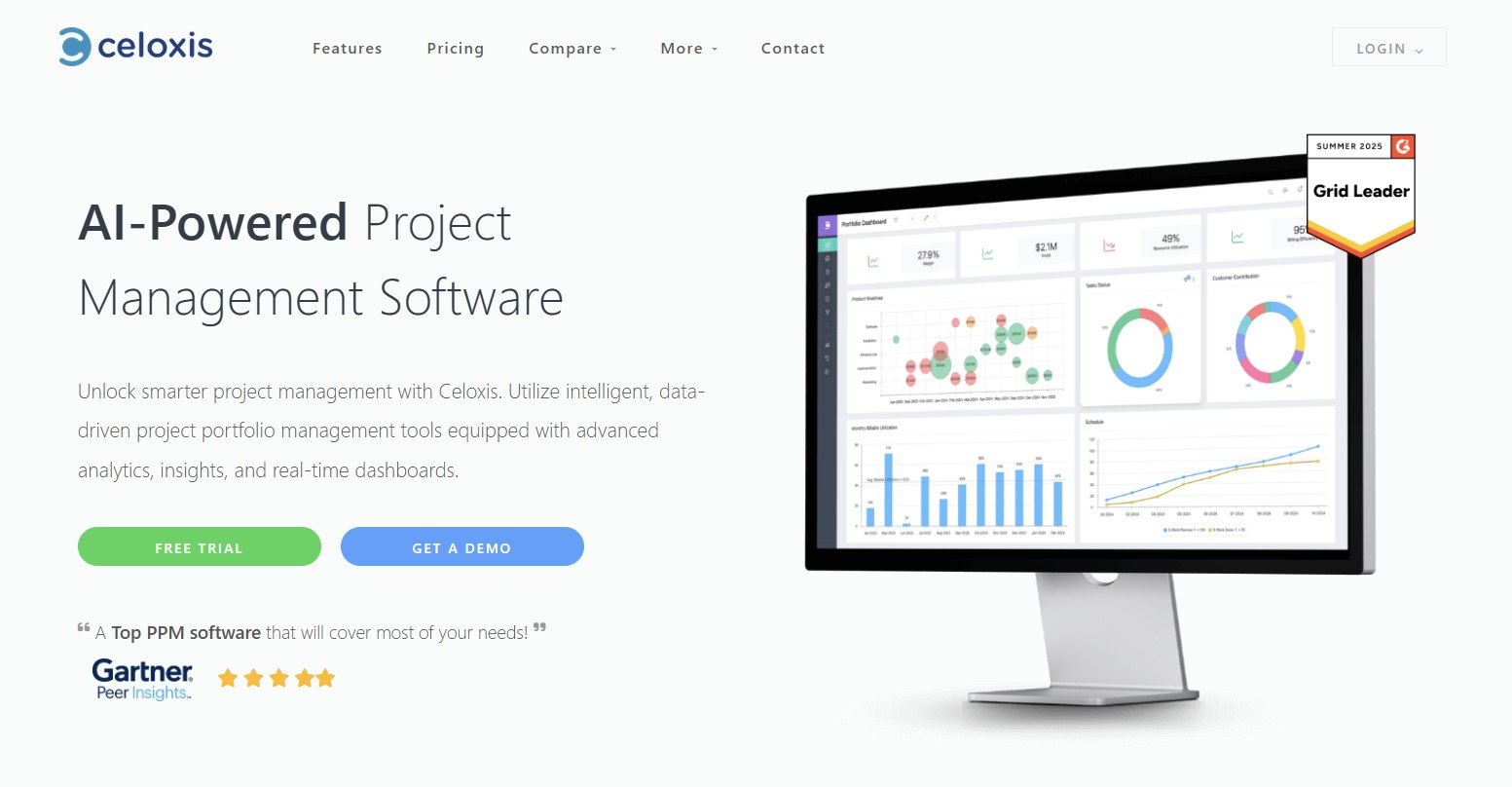
In the rapidly shifting landscape of SaaS project management, 2026 has become the year of “The Great Consolidation.” Companies are tired of “lite” task managers that require five different integrations just to see a budget report. They are looking for the “Single Source of Truth.”
Enter Celoxis. While other platforms have chased Gen-Z aesthetics and over-simplified interfaces, Celoxis has spent the last two decades perfecting a powerhouse engine designed for one thing: managing complex, high-stakes projects for mid-to-large enterprises.
Is Celoxis still the king of comprehensive project management in 2026? Let’s dive into the details.
1. What is Celoxis? An Overview
Celoxis is an all-in-one Project Portfolio Management (PPM) solution. Unlike Trello or Asana, which focus primarily on “tasks,” Celoxis focuses on the Project Lifecycle. It combines project planning, resource management, time tracking, expense management, and advanced reporting into a single dashboard.
In 2026, it remains one of the few platforms that offers both SaaS (Cloud) and On-Premise deployment, making it a favorite for government agencies, healthcare providers, and financial institutions with strict data sovereignty requirements.
2. Key Features: The “Heavy Hitters”
A. Advanced Project Planning
The Gantt chart in Celoxis isn’t just a visual aid; it’s a living, breathing scheduling engine.
-
Automatic Scheduling: If a predecessor task is delayed, Celoxis automatically shifts the entire project schedule based on dependencies.
-
Multi-Project Views: In 2026, the ability to see inter-project dependencies is crucial. Celoxis allows you to see how a delay in “Project A” will physically impact “Project B” across the portfolio.
B. Resource Management (The Efficiency Killer)
Most project failures aren’t due to bad ideas, but over-allocated people. Celoxis’s resource management tool is its “killer feature.”
-
Real-Time Workloads: You can see exactly who is over-burdened across the entire organization.
-
Skill-Based Routing: You can assign tasks based on specific skill sets, ensuring the right person is on the right job.
-
Heat Maps: The 2026 interface uses intuitive color-coded heat maps to identify burnout risks before they happen.
C. Financial Management & Budgeting
Celoxis treats your project like a business. It tracks:
-
Planned vs. Actual Costs: See your margins in real-time.
-
Profitability Tracking: Not just “is the work done?” but “did we make money?”
-
Revenue Forecasting: In 2026, Celoxis’s AI-driven forecasting predicts your end-of-quarter revenue based on current project velocities.
3. The 2026 AI Evolution: “Smart Analysis”
Celoxis hasn’t ignored the AI revolution. In 2026, they introduced Celoxis Insights AI. Unlike chatbots that just summarize text, this AI analyzes the data:
-
Risk Prediction: It identifies projects that have a 70% statistical probability of missing their deadline based on historical team performance.
-
Automated Time-Filling: It suggests time-log entries for team members based on their activity within the platform, reducing the “Friday afternoon time-sheet dread.”
-
Bottleneck Detection: The AI flags specific individuals or departments that are consistently becoming “blockers” in the workflow.
4. User Experience (UX) and Interface
Historically, Celoxis was criticized for being “dense.” In 2026, the UI has undergone a major refinement.
-
The Custom Dashboard: Every user (from the CEO to the Junior Developer) can build a dashboard that shows only what they need to see.
-
Client Portals: You can invite your clients into a “white-labeled” portal where they can see progress, approve documents, and view reports without seeing your internal team discussions or margins.
5. Pros and Cons: A Balanced View
The Pros:
-
All-Inclusive Pricing: Unlike competitors who charge extra for “Premium Reporting” or “Resource Management,” Celoxis includes almost everything in their standard enterprise tier.
-
Deep Customization: You can create custom fields, custom workflows, and custom formulas for almost any data point.
-
Robust API: For tech-heavy companies, the Celoxis API allows for seamless integration with Jira, Salesforce, and Slack.
-
Scalability: It handles 50 projects as easily as it handles 5,000.
The Cons:
-
Learning Curve: This is not “plug and play.” It takes 2–4 weeks for a team to fully master the depth of the software.
-
Mobile App: While improved in 2026, the mobile experience is still primarily for “viewing and updating” rather than “complex planning.”
-
Overwhelming for Small Teams: If you only have 5 employees and 2 projects, Celoxis is like using a sledgehammer to crack a nut.
6. Celoxis vs. The Competition (2026 Landscape)
| Feature | Celoxis | Monday.com | MS Project |
| Primary Focus | Enterprise PPM | Team Collaboration | Industrial Planning |
| Resource Tracking | Built-in / Advanced | Basic Add-on | High Complexity |
| Financials | Integrated | Requires 3rd Party | Separate Tooling |
| Deployment | Cloud & On-Premise | Cloud Only | Cloud & Desktop |
7. Pricing and ROI
In 2026, Celoxis maintains a transparent pricing model.
-
Cloud: Roughly $22–$25 per user/month.
-
On-Premise: Custom quotes based on seat count.
The ROI Argument: For a company losing 10% of their billable hours to poor resource allocation or missing 2 major project deadlines a year due to “scheduling blindness,” Celoxis pays for itself within the first 6 months. It reduces the need for multiple “niche” apps, consolidating your tech stack and lowering your total cost of ownership (TCO).
8. Security and Compliance
For many AdvanceTec readers, security is the “Dealbreaker.”
-
SOC 2 Type II Compliant.
-
GDPR & HIPAA Ready.
-
99.99% Uptime: Their 2026 infrastructure is distributed across global AWS nodes, ensuring zero-latency performance for international teams.
9. Final Verdict: Should You Switch to Celoxis in 2026?
Celoxis is not for the “casual” project manager. It is for the Professional Project Manager (PMP) and the PMO Director who is tired of data being scattered across spreadsheets and Slack threads.
Buy Celoxis if:
-
You manage complex portfolios with shared resources.
-
You need to track project profitability and margins.
-
You want a tool that grows with your company’s complexity.
Skip Celoxis if:
-
You just need a simple checklist for your team.
-
You have a low tolerance for initial software configuration.
AdvanceTec Rating: 4.7 / 5 Stars
“The most powerful project management engine on the market that doesn’t require a PhD to use—but does require a commitment to excellence.”
10. Next Steps for Implementation
If you’re considering Celoxis for your 2026 digital transformation:
-
Request a Trial: Use a real-world project to test the Gantt engine.
-
Audit Your Resources: Gather your team’s skill sets and availability data.
-
Setup a Demo: Ask their engineers specifically about their AI Insights for your industry