

1. Founding and Origins
Databricks was founded in 2013 by a group of computer scientists from UC Berkeley, including Ali Ghodsi, Matei Zaharia, Ion Stoica, Patrick Wendell, Reynold Xin, Arsalan Tavakoli, and Andy Konwinski. The company emerged from the creators of Apache Spark, an open-source distributed computing framework that revolutionized big data processing.
The founders envisioned a platform that would unify data engineering, machine learning, and analytics in a single environment. This vision became the foundation of Databricks’ Lakehouse architecture, which combines the best of data lakes and data warehouses.
2. The Lakehouse Architecture
Databricks pioneered the Lakehouse concept, which integrates the flexibility of data lakes with the reliability and performance of data warehouses.
- Data Lakes: Store raw, unstructured data at scale.
- Data Warehouses: Provide structured, query-optimized data for analytics.
- Lakehouse: Offers both — enabling organizations to run BI, AI, and ML workloads on a single platform.
This innovation solved a major pain point for enterprises: the need to maintain separate systems for analytics and machine learning.
3. Explosive Growth and Valuation
Databricks has experienced extraordinary growth:
- Revenue Run-Rate (2025): $4.8 billion
- Year-over-Year Growth: >55%
- Valuation: $134 billion after raising over $4 billion in Series L funding
- Funding Raised: $19.2 billion from investors including Andreessen Horowitz, Insight Partners, and NEA
This makes Databricks one of the most valuable private technology companies in the world.
4. Product Portfolio
Databricks offers a suite of products that unify data and AI capabilities:
- Databricks Lakehouse Platform: Core environment for data engineering, analytics, and ML.
- Delta Lake: Open-source storage layer that brings reliability to data lakes.
- MLflow: Open-source platform for managing machine learning experiments and deployments.
- Databricks SQL: Enables BI and SQL analytics directly on the Lakehouse.
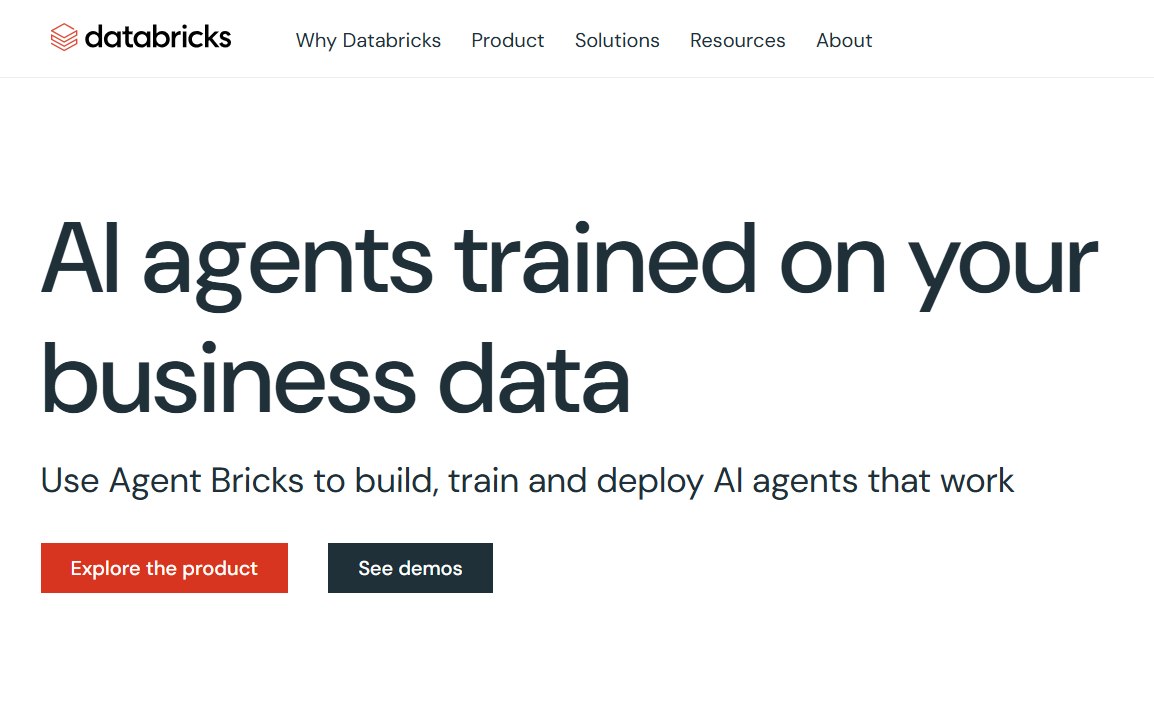
- Agent Bricks & Lakebase (2025): New initiatives to power intelligent data applications.
5. AI and Machine Learning Leadership
Databricks has positioned itself as a leader in AI infrastructure:
- Over $1 billion revenue run-rate from AI products.
- MLflow has become a standard tool for ML lifecycle management.
- Databricks integrates with large language models (LLMs) and generative AI, enabling enterprises to deploy AI at scale.
This makes Databricks a direct competitor to Palantir, Snowflake, and cloud giants in the AI race.
6. Customer Base and Use Cases
Databricks serves thousands of enterprises worldwide, across industries:
- Finance: Fraud detection, risk modeling.
- Healthcare: Genomics, patient analytics.
- Retail: Personalization, demand forecasting.
- Manufacturing: Predictive maintenance, supply chain optimization.
Its ability to handle both structured and unstructured data makes it versatile for diverse use cases.
7. Competitors and Market Position
Databricks competes with:
- Snowflake: Strong in cloud-native data warehousing.
- Palantir: Focused on government and operational AI.
- Google BigQuery, AWS Redshift, Microsoft Azure Synapse: Cloud-native analytics platforms.
Databricks differentiates itself by offering a unified platform for analytics and AI, rather than siloed solutions.
8. Culture and Workforce
Databricks employs over 8,000 people globally. Its culture emphasizes innovation, open-source collaboration, and customer-centricity.
The company continues to support open-source projects like Apache Spark, Delta Lake, and MLflow, reinforcing its reputation as a developer-friendly ecosystem.
9. Controversies and Challenges
Despite its success, Databricks faces challenges:
- Competition: Cloud giants may undercut pricing.
- Complexity: Enterprises need skilled teams to fully leverage Databricks.
- Market Saturation: As AI adoption grows, differentiation becomes harder.
Still, Databricks’ rapid growth suggests it is navigating these challenges effectively.
10. The Future of Databricks
Databricks aims to become the operating system for data and AI applications. Its roadmap includes:
- Expanding Agent Bricks for intelligent automation.
- Growing Lakebase to handle real-time data at scale.
- Deepening AI integration across industries.
With its valuation, growth, and product innovation, Databricks is poised to remain a central player in the AI-driven enterprise landscape.
Conclusion
Databricks is no longer just the company behind Apache Spark. It has transformed into a global leader in data and AI, with a valuation of $134 billion, revenues exceeding $4.8 billion, and a platform that unifies analytics, machine learning, and AI.
The 10 things you must know are:
- Founded in 2013 by Spark creators.
- Invented the Lakehouse architecture.
- Achieved explosive growth and $134B valuation.
- Offers a robust product portfolio (Lakehouse, Delta Lake, MLflow).
- Generates >$1B from AI products.
- Serves diverse industries worldwide.
- Competes with Snowflake, Palantir, and cloud giants.
- Employs 8,000+ people with strong open-source culture.
- Faces challenges in competition and complexity.
- Aims to be the operating system for data and AI.