


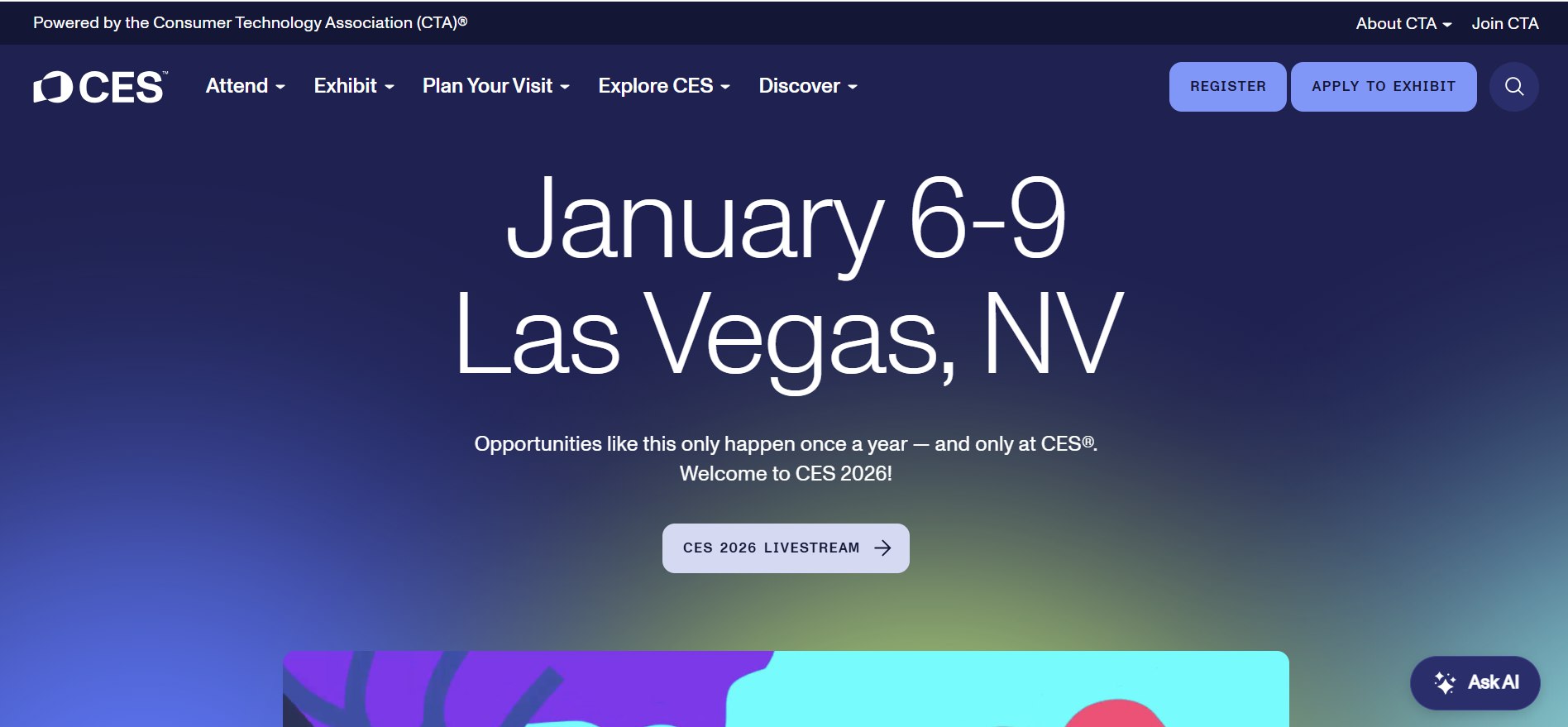
The Consumer Electronics Show (CES) has always been the world’s biggest stage for unveiling futuristic technology. In January 2026, Las Vegas once again became the epicenter of innovation, with thousands of companies presenting products that promise to reshape our homes, workplaces, and lifestyles. Unlike past years dominated by speculative demos, CES 2026 emphasized deployable products—AI, robotics, and smart devices ready for real-world use. Here are ten things you should know about CES 2026.
1. AI Everywhere: From Side Act to Core Infrastructure
- Artificial intelligence was the dominant theme. Companies no longer pitched AI as a futuristic concept; instead, it was embedded in nearly every device.
- Examples: Samsung’s AI TVs that personalize content, Omnia’s health devices with predictive analytics, and LG’s CLOiD household robot.
- Impact: AI is shifting from novelty to necessity, powering both consumer gadgets and enterprise workflows.
2. LG’s CLOiD: The “Zero Labor Home” Robot
- LG unveiled CLOiD, a household robot designed to handle chores like cooking prep, laundry, and appliance coordination.
- Unlike earlier prototypes, CLOiD demonstrated emotional intelligence, interacting naturally with users.
- Significance: Marks a leap toward practical home robotics, moving beyond vacuum cleaners to full-service assistants.
3. Samsung’s AI TV Redefines Entertainment
- Samsung introduced a Super Quantum Dot AI TV, capable of real-time content optimization.
- It adapts brightness, sound, and recommendations based on user behavior.
- Trend: TVs are evolving into AI-powered hubs for entertainment and smart home integration.
4. Xreal AR Glasses Go Mainstream
- Xreal launched consumer-ready AR glasses available immediately.
- These lightweight glasses overlay digital information seamlessly, targeting gaming, productivity, and everyday use.
- Why it matters: AR is finally moving from niche to mainstream, with CES 2026 marking a turning point.
5. Health Tech: Preventive Care at Home
- Companies showcased health mirrors and AI-driven diagnostic tools.
- Omnia’s devices can predict potential health risks, offering preventive care without hospital visits.
- Implication: Healthcare is shifting toward personalized, at-home monitoring.
6. Robotics Beyond the Home
- Boston Dynamics presented an upgraded Atlas robot for industrial operations.
- Agile and AI-enhanced, Atlas is designed to transform logistics and manufacturing.
- Takeaway: Robotics is expanding from consumer convenience to enterprise-scale productivity.
7. Gadgets You Can Buy Now
- Unlike past CES events, many products were immediately available for purchase.
- Examples: Dell laptops, Soundcore audio gear, TCL’s Super Quantum Dot TV, and DuRoBo’s Kindle alternative.
- Shift: CES is becoming less about prototypes and more about real consumer launches.
8. Smarter Screens Everywhere
- Beyond TVs, CES 2026 featured AI-powered monitors and laptops.
- Smarter displays adapt to user needs, from gaming to productivity.
- Trend: Screens are evolving into intelligent interfaces rather than passive displays.
9. AI in Mobility and Transportation
- Automotive companies showcased AI-driven in-car assistants and autonomous features.
- Vehicles are increasingly becoming smart devices on wheels, integrating entertainment, safety, and navigation.
- Future outlook: CES 2026 reinforced that cars are central to the AI revolution.
10. From Hype to Execution
- The overarching theme was execution over speculation.
- Companies focused on products that deliver measurable value, not just futuristic concepts.
- Consumer takeaway: 2026 marks the year when AI and robotics stop being buzzwords and start being everyday tools.
Conclusion
CES 2026 demonstrated that the future of technology is no longer about distant promises—it’s about AI, robotics, and smart devices ready for deployment today. From LG’s CLOiD robot to Samsung’s AI TVs and Xreal’s AR glasses, the event highlighted how innovation is becoming practical, accessible, and transformative. For consumers, businesses, and society, CES 2026 was a clear signal: the AI-driven future has arrived.